Molleat: Redefining Visual Communication Through Situjuh Nazara's Distinctive Type Design
Origin and Design Philosophy Behind Molleat
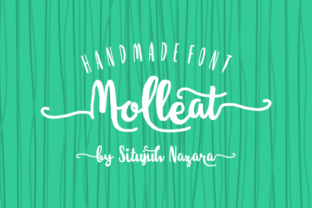
Every typeface carries a story, and few recent releases have sparked as much genuine curiosity among design professionals as Molleat, the creation of Indonesian type designer Situjuh Nazara. Rather than simply offering another variation on existing sans-serif or serif families, Nazara approached Molleat with a clear intention: to craft a letterform that bridges expressive individuality with everyday readability. The font does not scream for attention, yet it refuses to fade into the background. This balance is difficult to achieve, and it is precisely what makes Molleat a compelling addition to the contemporary typographic landscape.
When examining the letterforms closely, one notices subtle curvature in strokes that would typically remain rigid in conventional geometric fonts. Nazara's background in both digital and calligraphic traditions becomes evident. There is a softness to the terminals, a gentle lift in the bowls of lowercase letters, and an overall rhythm that feels organic without sacrificing precision. This is not a font that was assembled purely from mathematical parameters; it breathes. For educators teaching typography fundamentals, Molleat offers a useful case study in how small adjustments to standard proportions can yield a distinctly different voice.
Typographic Characteristics That Set Molleat Apart
Understanding what makes Molleat distinctive requires moving beyond superficial observations. The x-height is generous, which enhances legibility at smaller sizes and makes the font suitable for both body text and display contexts. Counter spaces are open, reducing visual crowding in paragraphs. The ascenders and descenders maintain a harmonious relationship with the cap height, preventing the overall texture from feeling either cramped or overly stretched.
One particularly notable feature is the treatment of diagonal strokes. In letters such as k, K, v, V, w, and W, Nazara introduced a slight taper that adds tension and movement. This small intervention prevents the characters from appearing static. Similarly, the lowercase a and g adopt a double-story form, which aligns with reader expectations for high legibility while still carrying the font's unique proportional signature.
The punctuation set and numerals also received careful attention. The lining figures align neatly with the cap height, making them ideal for annual reports, financial documents, and data-heavy presentations. The ligature set, while not extensive, covers the essential pairs and adds a polished feel to justified text blocks. Researchers studying reading behavior might note that Molleat's letter spacing and kerning pairs produce consistent inter-letter gaps that reduce cognitive load during extended reading sessions.
Real-World Use Cases Across Professional Domains
Business owners seeking to differentiate their brand identity often struggle to find a typeface that feels both professional and approachable. Molleat fills that niche effectively. A boutique hotel chain, for example, might use the font across website headings, room signage, and printed collateral to create a unified visual language that feels warm yet authoritative. The font's moderate stroke contrast ensures that it reproduces well across various substrates, from glossy brochure paper to uncoated recycled stock.
For independent creators and freelancers, Molleat offers versatility that reduces the need to license multiple type families. A graphic designer working on a podcast brand identity could employ the regular weight for episode descriptions, the bold for episode titles, and the light weight for quote cards on social media. This single-family approach simplifies workflow and maintains visual consistency across platforms.
Content creators producing video thumbnails, course materials, or digital products benefit from Molleat's strong presence at medium to large sizes. The letterforms retain their character even when rendered at 72 points or higher, which is not always the case with fonts designed primarily for body text. On-screen, the font reads clearly across different resolutions, from Retina displays to standard monitors, a testament to Nazara's attention to hinting and outline quality.
Educational institutions can leverage Molleat for both instructional materials and institutional branding. The font's clarity supports readers with varying literacy levels, and its approachable tone reduces the formality that can create distance between an institution and its students. A university style guide built around Molleat would find the typeface equally effective in academic journals and campus event posters.
Pairing Molleat with Complementary Typefaces
No single font exists in isolation, and understanding how Molleat interacts with other typefaces expands its practical value. For projects requiring a secondary typeface for captions, footnotes, or data tables, a neutral sans-serif such as Work Sans or Source Sans Pro provides a clean counterpart without competing for attention. The contrast between Molleat's slightly rounded character and a more mechanical sans-serif creates a layered reading experience that guides the eye naturally.
For those seeking a more harmonious pairing, a humanist serif like Joanna or Legacy Serif can complement Molleat's warmth with an equally organic structure. In long-form editorial layouts, Molleat might handle headlines and pull quotes while the serif partner manages body copy. This combination respects traditional reading conventions while introducing a contemporary accent.
Hobbyists exploring typography for personal projects can experiment with pairing Molleat with monospace fonts for code snippets or technical notes. The contrast between Molleat's flowing curves and the rigid uniformity of a monospace face creates visual interest in documentation, newsletters, or hybrid text-and-code publications.
Technical Considerations for Implementation
Adopting Molleat across a project or organization requires awareness of a few technical factors. The font includes multiple weights, typically ranging from Light to Bold, with corresponding italics. Checking the specific weight availability before committing to a design system is prudent. For web implementation, loading Molleat via standard @font-face rules works reliably across modern browsers. The file sizes are reasonable, and the font subsetting options available through most web font services allow for further optimization.
Print professionals should test Molleat on their intended paper stocks before finalizing large runs. While the font performs admirably on coated papers where fine details are preserved, uncoated and textured papers can cause the subtle stroke variations to appear less defined. Running a small press proof is recommended for any project where brand consistency across print and digital is critical.
Accessibility is another dimension worth considering. Molleat's open counters and generous x-height contribute positively to readability for readers with visual impairments or dyslexia. However, as with any typeface, sufficient line spacing and appropriate contrast ratios remain essential. Pairing Molleat with a robust accessibility checklist ensures that the font's natural advantages are fully realized.
Workflow Integration for Design Teams
Design teams evaluating Molleat for integration into existing workflows will find the font compatible with major design tools. Adobe Creative Cloud applications, Figma, Sketch, and Affinity products all handle the font without issues. The OpenType features, including stylistic alternates and ligatures, are accessible through standard character panels and OpenType menus.
For teams operating across multiple file formats and platforms, testing font rendering on Windows, macOS, Linux, iOS, and Android is advisable. While Molleat maintains consistent outline quality, rasterization differences across operating systems can affect perceived sharpness. Situjuh Nazara's careful hinting work minimizes these discrepancies, but environment-specific testing remains a best practice.
Version control for font assets is an often overlooked aspect of design operations. Storing Molleat in a shared asset library with clear naming conventions and version tracking prevents confusion when team members update their local font installations. This organizational discipline becomes increasingly important as a brand scales and the font is used across more touchpoints.
Broader Trends in Type Design and Molleat's Place Within Them
The contemporary type design landscape shows a clear movement away from sterile geometric uniformity toward fonts that carry personality and contextual sensitivity. Molleat aligns with this trend gracefully. It does not imitate handwriting nor does it reject the precision that digital tools enable. Instead, it occupies a middle ground that respects both the craft of calligraphy and the demands of modern media.
Another observable trend is the growing interest in typefaces designed by non-Western designers. Situjuh Nazara's perspective enriches the global typographic conversation, bringing sensibilities that differ from the dominant European and North American traditions. For multinational brands seeking to communicate authentically across cultures, choosing a font like Molleat signals an awareness of and respect for diverse design voices.
As variable font adoption continues to grow, it is worth noting whether Molleat supports this format. While the initial release may rely on static weights, the design system underlying Molleat would lend itself well to a variable version. The gradual transition between weights and the optical size adjustments possible in variable format could unlock even broader applications for the font in responsive web design and adaptive publishing.
Feedback from Early Adopters and Community Reception
Since its release, Molleat has garnered attention from type enthusiasts and design professionals who appreciate its versatility. Common praise centers on the font's ability to maintain readability at small sizes while offering enough distinctiveness to function as a brand typeface. Users have noted that the italics are particularly well executed, with a genuine cursive influence rather than a simple mechanical slant.
Some designers have remarked that Molleat's lighter weights require careful handling on backlit screens where thin strokes can appear overly delicate. Adjusting the font weight or increasing contrast in the surrounding design elements usually resolves this concern. Such feedback underscores the importance of testing any typeface in its intended viewing environment rather than relying solely on specimen sheets.
The typography community has also responded positively to the transparency with which Nazara shared the design process. Articles and posts detailing the evolution of individual characters have helped users understand the decisions behind the final forms. This openness aligns with E-E-A-T principles by demonstrating real expertise and a willingness to engage with the community beyond simply releasing a product.
Selecting Molleat for Long-Term Projects
When choosing a typeface for projects expected to last several years, considerations extend beyond immediate visual appeal. Licensing terms, future updates, and the designer's ongoing support matter. Molleat's licensing options typically accommodate both desktop and web use, but verifying the specific terms for commercial redistribution, embedding in mobile apps, or use in logo trademarks is necessary.
The resale value of design work is another angle. Assets built on well-crafted typefaces retain their professional appearance longer than those reliant on trend-driven fonts. Molleat's design is not aggressively fashionable; it avoids extreme proportions or decorative flourishes that might date quickly. This restraint makes it a sound investment for brands and organizations that value longevity in their visual identity.
For educational institutions purchasing site-wide licenses, the cost per user often becomes a deciding factor. Comparing Molleat's pricing with similarly positioned typefaces from independent foundries reveals competitive rates, especially considering the quality of the character set and the attention to detail evident in the kerning and spacing tables. Bulk licensing inquiries may yield additional discounts for large deployments.
Looking Ahead: Molleat in Emerging Media
As augmented reality, virtual reality, and other immersive media mature, the demand for typefaces that perform well in three-dimensional environments will rise. Molleat's clean forms and moderate stroke contrast suggest it could adapt to such contexts with minimal modification. The font's readability from varying angles and distances would require empirical testing, but its foundational design principles are well suited to these challenges.
In the realm of motion design, Molleat's consistent stroke weights and open counters facilitate smooth interpolation between weights for animated typography. Kinetic typography projects, whether for broadcast titles or social media content, would benefit from the font's predictable behavior under transformation. Motion designers looking for a typeface that moves gracefully without unexpected distortion should add Molleat to their evaluation list.
The growing emphasis on inclusive design also positions Molleat favorably. Its letterforms avoid eccentric shapes that might confuse readers who are not fluent in Latin script or who rely on pattern recognition strategies. As global communication platforms seek typefaces that accommodate diverse audiences, Molleat's clear, friendly character becomes a strategic asset rather than merely an aesthetic choice.