Paintbrush
When a Font Feels Like It Was Dipped in Ink and Hurled at the Page
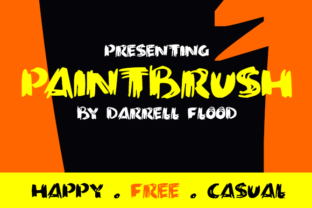
Some typefaces sit quietly on the screen, neat and obedient. Then there is Paintbrush. This is not a font that whispers. It growls, splatters, and leaves a mess—in the best possible way. Created by the designer Darrell Flood, Paintbrush belongs to that rare category of lettering that feels as if it were physically painted by hand, with a loose, thick, bristly brush that barely stays within the lines. The strokes are uneven. The edges are ragged. Ink appears to have sprayed outward from each letterform, as if the brush flicked across the paper with a kind of joyful recklessness.
What makes Paintbrush immediately arresting is its refusal to be perfect. In a world where digital type often strives for mathematical precision, this font leans into imperfection. The letters are bold, almost aggressive in their weight, yet they carry a casual, playful energy that is hard to replicate with more refined typefaces. It is the kind of font you would expect to see stamped on a concert poster for a punk band, scrawled across the cover of a zine, or splashed onto a chalkboard in a hip cafe. But its appeal goes far beyond those stereotypes.
This article explores what Paintbrush actually is, why it works, who might find it useful, and how to decide whether it fits your next project. No fluff, no hype—just a grounded look at a font that feels like it has a pulse.
What Exactly Is Paintbrush?
Paintbrush is a digital typeface that simulates the look of hand-lettering created with a broad, stiff brush loaded with paint. Unlike many brush fonts that feel clean or controlled, Paintbrush leans into the raw, unpredictable texture of real brushwork. Each character appears to have been painted in a single, confident stroke, with variations in thickness, slight wobbles in the line, and tiny splatters that cling to the edges of the letters. The overall effect is both rugged and lively.
The font was designed by Darrell Flood, a type designer known for creating fonts that feel handcrafted and full of personality. Paintbrush is available in a single weight—thick and bold—but that is really all it needs. A lighter version would miss the point entirely. The weight is what gives the font its presence. It demands attention without shouting for it.
Key characteristics include:
- Loose, expressive strokes that avoid mechanical repetition.
- Thick, bristly line quality with visible texture and irregular edges.
- Splatter and ink spray effects built into the letterforms.
- Inconsistent letter heights and baselines that mimic natural hand-painting.
- Limited character set focused on uppercase and basic punctuation, though some versions include alternates and ligatures.
It is not a font for body text. It is not a font for long paragraphs. Paintbrush is a display typeface, meant to be used in short bursts where impact matters more than readability over distance.
Where Paintbrush Shines: Purpose and Practical Use Cases
The natural habitat of Paintbrush is any context where a human, handmade feel is desired. It thrives in situations where you want to communicate energy, authenticity, or a sense of spontaneity. Here are a few areas where it performs exceptionally well:
Posters and Flyers
Whether it is a music festival, a garage sale, a community event, or a gallery opening, Paintbrush brings an immediate sense of urgency and excitement. The rough edges and splatters make the text feel like it was painted on a wall or a board, which can be especially effective for analog-style promotions in a digital age.
Product Packaging and Labels
Small-batch products, artisanal goods, and handmade items benefit from fonts that look handcrafted. A jar of hot sauce, a bag of coffee, or a bottle of craft beer labeled with Paintbrush tells the customer, "This was made by real people, not a machine." The font adds a layer of tactile authenticity that clean sans-serifs struggle to match.
Social Media Graphics and Banners
In a feed full of polished visuals, Paintbrush cuts through. It works especially well for bold quotes, announcements, or calls to action. Because the font is so visually heavy, it pairs best with plenty of whitespace or a dark background that lets the splatters pop.
Logos and Brand Identities
Brands that want to project a casual, creative, or rebellious personality can use Paintbrush as a primary logo font or as an accent. It is particularly suited for businesses in the creative industries: tattoo studios, skate shops, music labels, art schools, and independent publishers.
T-Shirts and Merchandise
Text on apparel often needs to be bold and readable from a distance, but it also needs character. Paintbrush fits that brief well. The irregular letterforms add visual interest when printed on fabric, and the splatter effects echo the textures of screen printing.
Who Should Consider Using Paintbrush?
This font is not for everyone, and that is part of its charm. It is aimed at:
- Graphic designers looking for a display font with genuine texture and personality.
- Small business owners who want their branding to feel approachable and handmade.
- Event organizers creating promotional materials for concerts, festivals, or workshops.
- Content creators and social media managers who need visuals that stand out in a crowded feed.
- Artists and makers who want their typography to reflect the same handcrafted quality as their products.
If you are designing something that needs to feel polished, corporate, or minimal, Paintbrush is probably wrong. But if you want warmth, energy, and a dash of controlled chaos, it could be exactly what you need.
Strengths of Paintbrush: What It Does Well
Paintbrush has several notable strengths that make it a valuable tool in the right context.
Authenticity. The font genuinely looks hand-painted. The subtle variations in stroke thickness and the irregular splatters create an organic feel that is difficult to achieve with filters or effects applied to a clean typeface. It does not try to hide its roughness; it celebrates it.
Visual impact. Because the letters are thick and the texture is prominent, Paintbrush commands attention even at small sizes. It works well as a headline or a hero element in a layout. It does not get lost in the noise.
Versatility with styles. Paintbrush pairs surprisingly well with other typefaces. Combining it with a clean sans-serif or a simple serif creates a pleasing contrast between rough and smooth, handmade and refined. It also works with textures, photographs, and illustrations without clashing.
Ease of use. Despite its complex appearance, Paintbrush is a standard OTF or TTF font file that installs like any other typeface. You do not need special software or advanced skills to use it. It behaves predictably in most design applications, though the splatters and irregularities are baked into the glyphs themselves.
Considerations and Limitations: What to Keep in Mind
No font is perfect for every situation, and Paintbrush has its own set of trade-offs that designers should be aware of.
Readability at small sizes. This is not a font for fine print. The thick strokes and rough edges can make small text difficult to read, especially on screens. If you need to communicate detailed information, use Paintbrush only for headlines and pair it with a more legible secondary font for body copy.
Limited character set. Depending on the version you obtain, Paintbrush may include only uppercase letters, basic punctuation, and numbers. Lowercase characters, accented letters, and extended symbols may be absent. This limits its use for multilingual projects or any text that requires special characters.
Potential for overuse. Because Paintbrush is so visually distinctive, using it too much or in too many contexts can become overwhelming. It works best as an accent font—a splash of personality rather than the entire meal. Using it for every heading, subheading, and piece of text in a layout can feel chaotic rather than intentional.
Licensing considerations. As with any font created by an independent designer, you should check the licensing terms carefully. Some versions are free for personal use but require a license for commercial projects. Darrell Flood's fonts are typically available through various foundries with clear licensing, so it is worth verifying before using Paintbrush in client work or products.
Real-World Scenarios: Seeing Paintbrush in Action
To understand how Paintbrush performs outside a demo file, consider a few concrete examples.
Scenario one: A local coffee shop wants a new chalkboard sign for their daily specials. The owner has decent handwriting but wants a consistent look. They print out large letters in Paintbrush, trace them onto the board, and the result looks like a professional sign painter spent an hour on it. The splatters and rough edges read as intentional design, not sloppiness.
Scenario two: A graphic designer is creating a poster for a punk band's reunion show. They need something that feels loud, gritty, and immediate. Paintbrush is set in all caps, sized at 120pt, and placed against a dark background with a slight grunge texture. The splatters from the font merge with the background texture, creating a cohesive look that feels like a screen-printed flyer from the 90s.
Scenario three: An online boutique selling handmade candles wants to refresh their packaging. They switch from a clean modern sans-serif to Paintbrush for the product names. The labels now feel warmer and more personal, and customers comment that the packaging makes the candles feel like gifts rather than commodities.
These scenarios share a common thread: Paintbrush is used not as a default choice but as a deliberate stylistic decision that aligns with the tone of the project.
How to Evaluate Whether Paintbrush Is Right for You
Before committing to Paintbrush for a project, ask yourself a few questions:
- Is the project casual or fun in tone? If the answer is no, Paintbrush may feel out of place.
- Will the text be large enough to read easily? If you need fine print, look elsewhere.
- Does the design benefit from a handmade, rough texture? Paintbrush adds texture even when you do not add a background effect.
- Can you pair it with a simpler font for body copy? This is almost always advisable.
- Do you have a license that covers your intended use? Always check this before finalizing a design.
If you answered yes to most of these, Paintbrush is probably a solid fit. If you hesitated, consider testing it in a mockup before committing. Sometimes a font that seems wrong on paper looks perfect in context, and vice versa.
The Craft Behind the Chaos: Darrell Flood's Approach
Darrell Flood is not a designer who churns out generic typefaces. His work often carries a strong handmade quality, and Paintbrush is a prime example of that philosophy. Flood's fonts tend to feel like artifacts—as if they were lifted from a painted sign, a weathered stencil, or a scribbled note. Paintbrush fits squarely in that tradition. It is a font that remembers it was once made by hand, and it refuses to pretend otherwise.
This is part of what gives Paintbrush its staying power. Trends come and go, but the appeal of authentic, handcrafted design endures. In a digital landscape where so much feels sanitized, a font that dares to be messy can be a breath of fresh air.
Final Thoughts: A Font with Guts
Paintbrush is not for every project. It is not for the faint of heart or the lover of strict grids. But for designers who want typography that feels alive, that carries the energy of a human hand moving across a surface, Paintbrush delivers. It is bold, imperfect, and full of character—exactly what you want when you need a font that stands out and actually says something.
If you are working on a project that calls for authenticity, energy, and a bit of grit, give Paintbrush a try. Let it splatter a little. That is what it was made for.