Sauvage: Evaluating a Modern Calligraphic Script Font for Your Design Projects
Choosing a typeface is rarely a trivial decision. For designers, developers, and brand managers, the right font can define the tone of an entire project. Among the many options in the script category, Sauvage has drawn attention as a font that blends contemporary structure with hand-lettered elegance. This article offers a balanced, objective evaluation of Sauvage to help you determine whether it aligns with your specific design goals, audience expectations, and practical constraints.
What Is Sauvage?
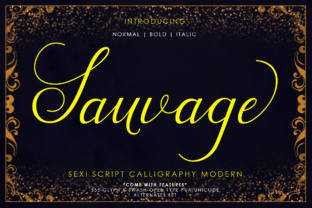
Sauvage is a script typeface that occupies a distinctive space between modern geometric design and traditional calligraphic form. Unlike rigidly uniform script fonts that can feel mechanical, Sauvage introduces organic variation in stroke width, letter connections, and terminal flourishes. Its letterforms carry the fluidity of brush or pen work, yet the overall rhythm is controlled and legible rather than overly ornamental.
The font includes a full character set with uppercase and lowercase letters, numerals, punctuation, and ligatures. The presence of contextual alternates and swashes gives users flexibility to adjust the visual density and flow of a word or phrase. This makes Sauvage suitable not only for display settings, such as headlines and logos, but also for shorter passages where a human, expressive touch is desired without sacrificing readability.
Why Consider Sauvage? Core Strengths and Benefits
Understanding a font's strengths helps you evaluate whether it solves a genuine problem in your work. Sauvage offers several practical advantages worth examining.
Balanced Expressiveness
The most frequently cited appeal of Sauvage is its ability to convey warmth, romance, or sophistication without tipping into excessive flourish. Many script fonts are either too restrained to feel authentic or too ornate to remain legible at smaller sizes. Sauvage strikes a middle ground: its calligraphic roots are evident, but the forms are simplified enough to function in contemporary layouts. For projects that require a friendly, approachable, or refined voice—such as wedding invitations, boutique branding, or lifestyle blogs—this balance is valuable.
Versatility Across Applications
Because Sauvage is neither a narrow display-only script nor a broad text font, it occupies a versatile middle zone. It works well in digital contexts such as social media graphics, website hero sections, and email headers, as well as in print materials like greeting cards, menus, and product labels. This versatility reduces the need to switch between multiple script fonts for different touchpoints, simplifying your typographic system.
Customization Through OpenType Features
Modern script fonts often provide stylistic alternatives, but Sauvage implements these features in a way that feels intentional rather than overwhelming. You can choose between alternate letterforms, select from multiple swash options, and control ligature behavior. This allows a designer to avoid repeating identical letterforms in adjacent words, creating a more natural, hand-drawn impression. For branding or identity work where consistency and uniqueness both matter, this level of control is a clear advantage.
Legibility at Moderate Sizes
A common tradeoff in script fonts is that elegance comes at the cost of readability, especially at smaller point sizes. Sauvage maintains relatively open counterspaces, clear ascenders and descenders, and consistent slant angles. As a result, it remains readable in body copy-sized settings (around 14–18 points) better than many highly ornamental scripts. This does not mean it functions as a text font for long paragraphs, but for short blocks of copy—pull quotes, taglines, captions—it performs well.
Tradeoffs and Considerations
No typeface is without limitations, and being aware of Sauvage's constraints is essential for making an informed decision.
Not Designed for Extended Reading
Like most script typefaces, Sauvage is not optimized for long-form reading. Its expressive letterforms demand more cognitive processing than a clean sans-serif or serif text face. If your project involves lengthy body text, product descriptions, or articles, Sauvage should be reserved for headers, accents, or short decorative passages. Pairing it with a neutral, highly legible companion font (such as a geometric sans-serif) is a practical approach to maintaining overall readability while preserving visual interest.
Limited Character Weight Options
Sauvage is typically available in a single weight or a small family. For projects that require a broad spectrum of weights—thin, regular, bold, black—this font may not provide the flexibility needed for complex hierarchies. In such cases, you might consider supplementing Sauvage with a more extensive script family or using it only for display purposes while relying on a different typeface for structural variation.
Potential for Overuse in Certain Contexts
Because Sauvage carries a romantic and somewhat ornate character, it may feel out of place in highly minimalist, corporate, or industrial design contexts. Brands that rely on a stark, utilitarian, or strictly professional image may find that even restrained use of a script font undermines their intended tone. Evaluating your audience's expectations and your brand's personality is crucial before committing to Sauvage as a primary typeface.
Licensing and File Format Considerations
Depending on where you download Sauvage, licensing terms may vary. Some versions are free for personal use only, while others require a commercial license for branding, merchandise, or web embedding. Before incorporating Sauvage into client work or commercial products, verify the license terms. Also confirm that the font files are provided in modern formats such as WOFF2 for web or OTF/TTF for print, and that OpenType features are fully supported in your design software.
Scenarios Where Sauvage Is a Strong Fit
Based on its characteristics, Sauvage is particularly well suited to the following situations:
- Wedding and event stationery: Invitations, save-the-dates, place cards, and programs benefit from the romantic, hand-crafted feel of Sauvage without becoming illegible or overly frilly.
- Small business branding: Boutiques, cafes, florists, bakeries, and artisan shops can use Sauvage to convey personality, craftsmanship, and approachability. Pair it with a clean sans-serif for a cohesive brand system.
- Social media and digital content: Headlines, quote graphics, and promotional banners in Instagram, Pinterest, or email campaigns gain visual warmth and differentiation from the standard sans-serif-dominated feeds.
- Product packaging: Labels for beauty products, gourmet foods, or handmade goods can use Sauvage to signal quality, care, and a human touch.
- Personal projects: Blogs, journals, portfolios, or creative side projects that aim for an authentic, expressive voice will find Sauvage easy to integrate.
Scenarios Where Alternatives May Be Worth Considering
In certain situations, another typeface might serve you better:
- Corporate or legal documentation: If your project demands a neutral, authoritative, or strictly professional tone, a script font—even a restrained one like Sauvage—could feel mismatched. A serif or sans-serif with a warm character might be more appropriate.
- Large text hierarchies: For a website or publication requiring multiple levels of headings, subheadings, and body text, a font family with several weights and italics will offer more design flexibility than Sauvage alone.
- Long-form editorial content: Magazines, blogs, or books with paragraphs of text need a typeface optimized for sustained reading. Sauvage is not intended for this purpose, and forcing it into that role will reduce reader comfort.
- Extremely small sizes: Even though Sauvage is more legible than many scripts, using it below 12–14 points in print or 16 pixels on screen will likely cause readability issues, particularly for users with visual impairments.
- Highly minimalist or industrial branding: Brands that rely on stark geometry, monochrome palettes, or utilitarian aesthetics may find that any script introduces a conflicting emotional tone. In such cases, a geometric sans-serif or a neutral slab serif would be more coherent.
Practical Decision-Making Insights
When evaluating Sauvage for your own work, consider these practical steps:
- Test in context. Download Sauvage and apply it to a realistic mockup of your project. View it at the actual sizes and on the actual media (screen, print, packaging) where it will appear. A font that looks charming in a specimen may behave differently in a dense layout.
- Assess your brand personality. Write down three to five adjectives that describe the tone you want to communicate (e.g., warm, professional, creative, trustworthy). Compare them to the emotional associations Sauvage carries. If there is alignment, proceed; if not, consider alternatives.
- Plan your typographic hierarchy. Decide where Sauvage will sit in your layout. Will it only be used for primary headings, or also for subheadings and short callouts? If you need more than one level of script, ensure your pairing font provides enough contrast in weight and style.
- Check technical requirements. Confirm that your design tools support OpenType features. Applications like Adobe Illustrator, InDesign, Photoshop, Figma, and Affinity Designer handle alternates and ligatures well. Web platforms like WordPress or Squarespace may require additional CSS to enable these features.
- Evaluate accessibility. For web use, test Sauvage against contrast ratios and readability standards. If your audience includes users with low vision or reading difficulties, limit Sauvage to decorative roles and rely on highly legible fonts for primary content.
- Consider future scaling. If your brand or project may grow to include new applications (e.g., expanding from a logo to a full website), consider whether Sauvage can accommodate that expansion or whether you will need supplementary typefaces.
Determining Whether Sauvage Aligns with Your Goals
Ultimately, the question is not whether Sauvage is a good font in absolute terms, but whether it is a good font for your specific purpose. If your project benefits from a human, romantic, or refined voice, and if you can reserve its use for display roles where legibility is manageable, then Sauvage offers a compelling combination of modern structure and calligraphic warmth.
If, on the other hand, your project requires extreme neutrality, long-form readability, or a wide weight range, then Sauvage may not be the most practical choice. In that case, you can still appreciate its qualities while acknowledging that another typeface better serves your constraints.
Font selection is ultimately a matter of matching a typeface's inherent strengths to a project's real-world requirements. Sauvage performs admirably within its intended scope. By understanding that scope clearly, you can make a confident, informed decision about whether to download Sauvage and integrate it into your next design.