Ballard: A Typeface That Bridges History and Strategic Communication
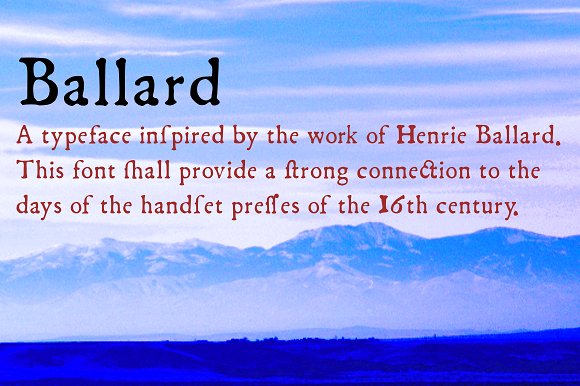
When you choose a typeface, you are making a decision that affects how your audience perceives your message – before they read a single word. Ballard is not just another serif font. It is a revival of a typeface used by Henrie Ballard, who operated on Fleet Street at the Signe of the Bear in London from 1597 to 1608. That era of printing was rich with ligatures, varied letterforms, and a tactile quality that modern digital fonts often lack. Ballard captures that feel while giving you over 600 defined glyphs, including Cyrillic and Greek character sets, plus a dramatic italic that reads almost like handwriting. For entrepreneurs, publishers, and creative professionals, understanding Ballard means understanding how a historically grounded typeface can support branding, communication, and long-term consistency.
Understanding Ballard’s Design and Capabilities
The most immediate reason to consider Ballard lies in its attention to detail. The typeface reproduces the many ligatures that made early printing expressive and interesting. Ligatures – combined letterforms like “fi,” “fl,” “ffi” – are not just decorative; they affect reading rhythm and visual texture. Ballard includes them as integral elements, not afterthoughts. This means your text can carry an authentic period feel without looking like a cheap imitation of an old book.
Every Proportional Lime font – and Ballard is one – comes with a complete guide to its Unicode extended character set. This is not a luxury; it is a practical necessity if you work with multiple languages or need special punctuation, mathematical symbols, or accented characters. The Cyrillic and Greek support means you can produce multilingual publications, websites, or packaging without switching fonts or losing consistency. The italic version, with its dramatic, almost handwritten appearance, works well for emphasis, quotes, or short headers where you want a human touch.
Yet the real value lies in how these features align with strategic goals. If your brand, publication, or project aims to convey craftsmanship, heritage, or intellectual depth, Ballard can become a visual anchor. It signals that you have paid attention to the details – and that you value authenticity over convenience.
Strategic Value for Brand Positioning
Branding is not just about logos and colors; it is about the consistent, deliberate cues you send at every touchpoint. A typeface like Ballard carries associations of printed books from the early 1600s, of careful typesetting by hand, of permanence. When you use it for headings, covers, or prominent text, you implicitly tell your audience that your content has depth. This is especially useful for small publishers, law firms, historical societies, or any practice that trades in expertise and tradition.
Consider a boutique publisher releasing a limited edition of classic literature. Using Ballard for chapter titles and pull quotes instantly connects the physical book to its historical roots. The reader feels the weight of the words before they turn the page. Similarly, a marketing agency working with a heritage brand – a distillery, a watchmaker, a fine furniture studio – can deploy Ballard in marketing collateral to reinforce the narrative of old-world quality. The typeface becomes part of the positioning strategy, not just decoration.
However, positioning requires intention. If you slap Ballard onto a modern tech startup’s landing page without any thematic reason, the disconnect will confuse your audience. The strategic use of Ballard depends on your brand story. Ask yourself: Does your product or service have roots in craftsmanship, tradition, or careful attention? If yes, Ballard can amplify that message. If you are selling speed, disruption, or simplicity, a more neutral typeface will serve you better.
Practical Applications and Use Cases
Because Ballard is highly expressive, it works best where you have control over layout and hierarchy. Here are several use cases where it can deliver strong results:
- Book covers and interior titles: The ligatures and varied letterforms give title pages a printed-from-metal impression. Pair Ballard with a clean sans serif for body text to maintain readability while adding character.
- Certificates, awards, and diplomas: The dramatic italic and historical associations lend an air of formality. Ballard can make a certificate feel like a document from a royal charter.
- Invitations and event materials: For weddings, galas, or literary events, Ballard’s hand-drawn italic feels personal and elegant. Use it sparingly for names, dates, or short phrases.
- Logos and wordmarks: A single word set in Ballard can become a recognizable mark, especially if your organization’s name is short. The font’s quirks make it hard to forget.
- Pull quotes and headings in publications: Drop Ballard into an otherwise neutral layout to draw the eye and signal importance. The contrast creates a natural hierarchy.
What about body text? Here you need to be careful. Ballard’s elaborate forms and low x-height (the height of lowercase letters) can tire the eye in long paragraphs. It is better reserved for display sizes – 18 points and above – or for very short passages. For extended reading, use a more legible companion face. The key is to think of Ballard as a seasoning, not the main course.
Integrating Ballard into Your Workflow
Adopting a typeface like Ballard is a decision that affects planning and operations. Before you commit, consider these practical steps:
- Test across media: Download the font and try it in print, on screen, and in mockups. The ligatures may behave differently depending on your software. Ensure your design tools support OpenType features.
- Study the character set: The Unicode extended set and language support are valuable, but only if you actually need them. If you plan to publish in Russian or Greek, test every character you need. If you rarely use accents, you may still appreciate the complete guide for future-proofing.
- Plan for pairing: Ballard pairs well with understated sans serifs like Proxima Nova or with clean serif body fonts like Merriweather. Create a basic style guide that defines which fonts go where: Ballard for headlines, secondary for body, another for captions. This prevents visual chaos.
- Assess file formats and licensing: Proportional Lime fonts typically include web, desktop, and app licenses. Confirm that your usage – especially for logos or commercial printing – is covered. Proper licensing protects you and the designer.
- Build a sample document: Before rolling out across a whole project, create one sample page or screen. Evaluate how Ballard feels when you read it, not just how it looks. Does it carry the emotional weight you intended? Is the italic too strong for your context?
Involving your team in this evaluation prevents misalignment. A designer might love the historical nuance, while a marketing manager worries about legibility on mobile. Address those concerns early.
Long-Term Value and Consistency
One of the strongest arguments for choosing Ballard is its potential to deliver consistent visual identity over time. Because the typeface is fairly distinctive, repeating its use across materials builds recognition. Think of Ballard as a signature. If you publish a series of books, each one with Ballard chapter titles, your audience will start associating that style with your imprint. If you run a blog that occasionally uses Ballard for drop caps or section headers, readers will sense a deliberate editorial voice.
Consistency, however, requires discipline. If you use Ballard for a year and then switch without reason, you lose the cumulative effect. Plan to use it for at least two to three years in a defined role. The long-term payoff is a cohesive brand system that feels intentional, not haphazard. The complete Unicode guide becomes a reference you can hand off to new designers or translators, ensuring that your Greek or Cyrillic documents maintain the same visual quality as your English ones.
Another dimension of long-term value is timelessness. Ballard is not a trendy sans serif that will look dated in five years. It evokes an era that most people respect and find aesthetically rich. As long as you use it tastefully, it will age well – unlike fonts that scream “2010s logo.” This makes it a smart choice for organizations that want to look established and trustworthy.
Avoiding Common Pitfalls
No typeface is a magic bullet. Ballard carries risks if used without clear goals or context. The most common mistake is overusing it. Because the ligatures and dramatic italic are so distinctive, they can quickly overwhelm a design. A page where every paragraph is set in Ballard will look cluttered and hard to read. Reserve it for moments that need emphasis or differentiation.
A second pitfall is ignoring legibility on small screens. The thin strokes and historical proportions can break up on low-resolution displays. If your primary audience reads on phones, test Ballard at 14 points on a 5‑inch screen. If it blurs or loses its charm, limit it to print or large screens.
Third, do not disregard audience expectations. A young, trend‑focused demographic might see Ballard as stuffy or academic. Conversely, an audience of historians, book lovers, or luxury buyers may see it as a sign of quality. Know your readers. If you guess wrong, the typeface can work against your message.
Finally, avoid the “set it and forget it” approach. Typeface management is part of web development and print production. Ballard’s glyph list is extensive, but not every system will load all characters correctly. Have fallback fonts in your CSS or print workflow. And always check that ligatures are turned on – some software defaults to disabling OpenType features.
Using Ballard intentionally means defining its role, testing its performance, and reviewing its effect on your audience’s perception. When you do that, the typeface becomes a tool for decision-making, not a decorative afterthought.
Making the Decision: Is Ballard Right for Your Project?
To decide, ask yourself three questions. First, does your project benefit from historical or handcrafted associations? Second, can you control the size and medium so that the typeface remains readable? Third, are you prepared to use it consistently for at least a year? If you answer yes to all three, Ballard is a strong candidate. If you hesitate on any, consider a more neutral font and reserve Ballard for limited, high-impact uses – like a single book cover or a certificate template.
For entrepreneurs and small business owners, Ballard can be a differentiator. In a marketplace flooded with generic designs, a typeface with history and character helps you stand out. For educators and publishers, it adds depth to materials that need to convey authority. For marketers and creators, it gives you a visual shorthand for “this matters.” The key is to treat it as a strategic asset, not a random download.
Ballard rewards those who plan ahead, think about context, and respect the craftsmanship behind it. When you use it well, you are not just typesetting – you are continuing a tradition that began on Fleet Street over four hundred years ago. That kind of continuity has real value, both aesthetic and commercial.