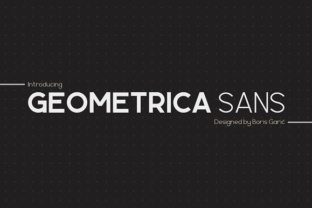
Geometrica Sans: Where Geometry Defines Typographic Clarity
Typography is often described as the art of arranging type, but at its core, it is the science of visual communication. Few typefaces embody this fusion of art and science as directly as Geometrica Sans. Designed from the ground up using only the most basic shapes in geometry—circles, straight lines, arcs, and right angles—this type family strips away ornamental excess to reveal something profoundly functional. Every curve, every stem, every terminal in Geometrica Sans originates from a deliberate geometric construction, making it an ideal choice for projects that demand precision, readability, and a distinctly modern aesthetic.
Unlike many sans-serif families that rely on optical corrections or organic humanist influences, Geometrica Sans embraces its mathematical DNA. The uppercase O is a near-perfect circle. The lowercase a begins with a clean circular bowl and a straight vertical stem. Even the more complex glyphs, such as the ampersand or the @ symbol, are built from combinations of elementary forms. This disciplined approach does not sacrifice character—instead, it gives the typeface a crisp, unified voice that resonates across media, from small mobile screens to oversized environmental signage.
The Structural Logic Behind Geometrica Sans
Understanding why Geometrica Sans works so well begins with its construction principles. Each letterform in this family is engineered around a modular system. The designer started with a set of core geometric primitives: the circle, the straight line segment, the arc, and the angle. These primitives were then combined, rotated, scaled, and positioned to generate every character in the Latin, Cyrillic, and Central European alphabets.
For instance, the letter B in Geometrica Sans is not drawn with freehand curves. Its two bowls are derived from identical circular arcs, stacked symmetrically along a vertical spine. The K uses a precise 45-degree diagonal meeting a vertical stem at a mathematically determined junction. Even punctuation marks like the comma or semicolon follow the same geometric logic—a small circle paired with a straight tail. This consistency means that when a designer sets a block of text in Geometrica Sans, the page feels inherently balanced. There are no unexpected thick-thin transitions or irregular spaces between letters.
Weight Spectrum from Thin to Black: A Toolbox for Hierarchy
One of the most practical aspects of Geometrica Sans is its availability in six carefully calibrated weights: Thin, Light, Regular, Medium, Bold, and Black. This range is not merely a set of font files; it is a graduated system that allows designers to build clear typographic hierarchies without switching typefaces.
- Geometrica Sans Thin – Extremely light and airy, ideal for overlays, watermarks, or elegant editorial headers where subtlety matters. Its hairline strokes retain geometric precision even at small sizes.
- Geometrica Sans Light – A step above Thin, offering enough presence for body text in display-heavy layouts while preserving a refined, minimalist feel.
- Geometrica Sans Regular – The workhorse of the family. Suitable for long-form reading, user interfaces, and documentation. The Regular weight hits the sweet spot between legibility and geometric purity.
- Geometrica Sans Medium – Slightly bolder, excellent for subheadings, pull quotes, and emphasizing key information without resorting to a full bold.
- Geometrica Sans Bold – Confident and commanding. Works perfectly for headlines, navigation labels, and call-to-action buttons. The geometric construction ensures bold characters remain open and readable rather than heavy.
- Geometrica Sans Black – The heaviest weight, designed for posters, hero sections, and branding where maximum impact is required. Despite its density, the Black weight retains the clean angles and circular bowls that define the family.
This weight spectrum means that a single project—say, a corporate annual report—can use Thin for page numbers, Light for captions, Regular for body copy, Medium for section headings, Bold for chapter titles, and Black for the cover headline. The result is a cohesive visual system where every element feels related, not borrowed from disparate fonts.
Language Support: Beyond Latin Scripts
Geometrica Sans was designed with an international audience in mind. Its character set includes extensive support for Latin (including Western, Central, and Eastern European diacritics), Cyrillic (both Russian and extended Cyrillic), and additional languages across Europe and beyond. This makes it a viable choice for multinational corporations, global brands, educational publishers, and government institutions that need consistent typography across multiple languages.
For example, the Cyrillic Ж (zhe) and Ф (ef) are constructed using the same geometric rules as their Latin counterparts. The circular bowls of Ф mirror the construction of O, while the central stroke of Ж uses identical angles to those found in K or X. This cross-script consistency is not trivial—many geometric fonts struggle to adapt to Cyrillic because the script includes curves and strokes that resist simple geometric forms. Geometrica Sans solves this elegantly, producing a unified brand voice whether a user reads English, Russian, Polish, or Romanian.
For educators and researchers working with multilingual texts, this language coverage removes the headache of mixing typefaces mid-document. A mathematics textbook that includes Latin theorems alongside Cyrillic author names can remain visually coherent. A consumer app launched simultaneously in Berlin, Warsaw, and Moscow can use a single font stack.
Real-World Use Cases Across Industries
The practical applications of Geometrica Sans span far beyond typical branding projects. Consider the following scenarios:
User Interface Design: Mobile apps and web dashboards benefit from Geometrica Sans because its geometric letterforms remain crisp at low resolutions and small pixel sizes. The Regular and Medium weights are particularly effective for navigation menus, button labels, and data tables. The consistent stroke width reduces visual noise, letting users focus on content rather than decorative flourishes.
Environmental Graphics: Wayfinding systems in airports, hospitals, and museums require typefaces that are legible from a distance and under varied lighting. The Bold and Black weights of Geometrica Sans, with their open counters and straight stems, perform exceptionally well when scaled to large formats. A directional sign reading "Gate B12" or "Emergency Exit" in Geometrica Sans Black communicates instantly because the geometric forms are unambiguous even when viewed at an angle.
Scientific and Technical Publishing: Researchers preparing papers, posters, or presentations often struggle with fonts that misrepresent mathematical symbols or chemical notations. Geometrica Sans handles numerals, operators, and Greek-derived symbols with the same geometric rigor as its letters. A physics equation set in Geometrica Sans Medium looks as precise as the data it represents.
Branding for Tech and Architecture Firms: Companies that want to communicate innovation, precision, and forward-thinking design naturally gravitate toward geometric typefaces. Geometrica Sans pairs well with logos that incorporate circular or angular motifs. A fintech startup or an architectural practice can use the Thin weight for elegant business cards and the Black weight for bold website headlines, creating a consistent identity that feels engineered rather than improvised.
Comparing Geometrica Sans to Other Geometric Typefaces
Geometrica Sans enters a field that includes well-known geometric sans-serifs like Futura, Avant Garde, and Century Gothic. However, several distinctions set it apart.
Purity of Construction: Many geometric fonts make compromises for legibility. For instance, Futura’s lowercase a uses a single-story design that can confuse readers accustomed to double-story forms. Geometrica Sans retains the double-story a and g, but constructs them using circular bowls and straight stems rather than calligraphic sweeps. This means it preserves geometric consistency without sacrificing the familiarity that supports fast reading.
Weight Range: While Futura and Avant Garde offer multiple weights, few geometric families provide a Thin weight as delicate as Geometrica Sans Thin or a Black weight as solid while still retaining geometric openness. The Thin weight, in particular, is rare among geometric faces because hairline strokes are difficult to manufacture with consistent geometry. Geometrica Sans achieves this by carefully scaling the circular and linear elements proportionally.
Language Coverage: As noted, the Cyrillic and Central European support in Geometrica Sans outpaces many classic geometric faces that were originally designed for Latin-only markets. For organizations working across Eastern Europe, this is a decisive advantage.
Optical Size Behavior: Geometrica Sans performs well at both small and large sizes without requiring separate optical cuts. The Regular weight at 10pt remains readable thanks to open aperture and generous spacing, while the same font at 72pt reveals the elegant geometric details that would be lost in a less carefully constructed face.
Practical Considerations for Designers and Developers
Adopting Geometrica Sans into a workflow is straightforward, but a few observations can help maximize its effectiveness.
- Pairing with other typefaces: Geometrica Sans pairs naturally with serif families that have geometric tendencies, such as those with slab serifs or monotone strokes. For editorial projects, a high-contrast serif for body text and Geometrica Sans for headlines creates a dynamic hierarchy. Avoid pairing it with highly calligraphic or script faces, as the contrast in construction philosophy can feel jarring.
- Spacing and kerning: Because Geometrica Sans is built from strict geometry, some letter pairs—particularly those involving diagonal strokes—may benefit from manual kerning adjustments. For example, the combination AV or To can appear slightly loose if default spacing is applied. Most design tools handle this automatically, but it is worth reviewing for logo or headline use.
- Web and mobile implementation: The font family is available in standard web formats. For digital products, loading only the weights you need (for instance, Regular, Medium, and Bold) keeps file sizes manageable while retaining full design flexibility. Consider using variable font technology if supported, which could allow seamless interpolation between weights.
- Accessibility: The geometric clarity of Geometrica Sans can improve readability for users with visual impairments, provided contrast ratios are maintained. The open counters and consistent stroke widths reduce ambiguity between similar characters (such as uppercase I and lowercase l), which is particularly helpful for dyslexic readers.
Why Geometrica Sans Deserves a Place in Your Typographic Toolkit
The value of a typeface is ultimately measured by how well it serves its intended purpose. Geometrica Sans excels in environments where clarity, consistency, and modernity are non-negotiable. Its geometric foundation is not a stylistic gimmick; it is a functional principle that yields predictable, reliable results across languages, media, and scales.
For educators preparing multilingual learning materials, the font reduces cognitive load by presenting text in a clean, uniform manner. For product designers, it streamlines interfaces and reinforces brand identity without introducing visual friction. For researchers and technical writers, it ensures that symbols, numbers, and letters coexist harmoniously. And for business owners overseeing corporate communications, it offers a versatile system that can be deployed from a single-page flyer to a multi-volume report with consistent quality.
Geometrica Sans does not try to mimic handwriting or inject personality through irregular shapes. Instead, it finds its voice through discipline. Every circle is true. Every line is straight. Every angle is deliberate. In a world cluttered with noisy design, that kind of clarity is not just beautiful—it is essential.