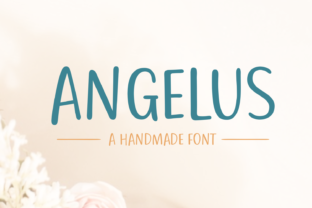
The Art of Imperfection: Why Angelus Stands Out in a Crowded Font World
Typography is often treated as a science. Ratios are measured, kerning is automated, and grids are followed with religious precision. But every once in a while, a typeface comes along that reminds us why we fell in love with letterforms in the first place. Angelus is exactly that kind of font. It does not try to fit neatly into a system. Instead, it carries the unmistakable warmth of something made by hand—something that started not on a computer screen, but on paper, with a brush and a steady wrist.
There is a growing hunger for authenticity in design. Audiences have grown tired of sterile, predictable visuals. They want texture. They want evidence of the human hand. Angelus delivers this in spades because it was not designed in a vector editor first. It was painted, scanned, and then carefully optimized for digital use. The result is a typeface that feels alive, imperfect in the best possible way, and yet surprisingly smooth to work with.
Where Angelus Comes From: A Brushstroke Origin Story
Understanding what makes Angelus special means understanding how it was born. The font began as physical brushstrokes on paper. Each letter was painted by hand, meaning every curve, every tail, and every connection was subject to the natural quirks of a real brush meeting a real surface. There is no symmetry that was forced into alignment. No anchor points were artificially nudged to make everything mathematically perfect. Instead, what exists is a faithful digital translation of those original painted forms.
After the painting phase, each character was scanned at high resolution. That scan became the blueprint. From there, the font underwent a careful process of digital optimization—not to strip away its character, but to make it usable in modern design environments without losing its handcrafted soul. The result is a font that behaves well in layout software, renders cleanly at various sizes, and still retains the slight irregularities that make it feel painted rather than typed.
This origin story matters because it directly affects how the font looks and feels in use. When you set a word in Angelus, you are not just selecting a typeface. You are invoking the physical act of someone painting those letters with a brush. That history is visible in every character, and it gives any project an immediate layer of human connection.
What Makes Angelus Different: Smooth Exterior, Playful Soul
One of the first things you notice when working with Angelus is how smooth its exterior is. This might sound contradictory for a brush-painted font. Many painted typefaces retain a rough, jagged edge that mimics the bristle marks of a dry brush. Angelus takes a different approach. The edges are clean and rounded, almost as if the paint was applied with a perfectly loaded brush and then left to settle without any disturbance.
This smoothness gives the font a versatility that rougher brush fonts often lack. You can use it at larger display sizes without the edges becoming distracting. You can place it on clean backgrounds, over photography, or even on colored surfaces, and it will hold its shape gracefully. The smooth exterior does not make it feel mechanical. On the contrary, it makes the playful underlying forms stand out even more.
The playfulness of Angelus lives in its proportions and the way letters connect. Ascenders and descenders have an almost whimsical length. The loops and swashes feel generous, as if the brush kept moving just a little longer than strictly necessary. This creates a rhythm that is hard to replicate with rigidly constructed fonts. Words set in Angelus seem to dance rather than march. That quality is invaluable for projects where you want to convey energy, creativity, or a sense of approachable sophistication.
Where Angelus Fits in Modern Design Workflows
It would be easy to assume that a hand-painted font like Angelus belongs only in niche, artisanal projects. The reality is far broader. Because of its smooth optimization and carefully balanced character set, Angelus integrates smoothly into modern design workflows across multiple industries.
Branding and logo design is one of the most obvious applications. Small businesses, creative agencies, and lifestyle brands often look for typefaces that feel distinctive but not overly aggressive. Angelus provides a signature look without screaming for attention. A logo set in this font reads as handcrafted and intentional. It works particularly well for businesses in the fields of baking, floristry, stationery, fashion, beauty, and hospitality. Any brand that wants to communicate warmth, care, and personality benefits from the visual language Angelus speaks.
Packaging design is another area where this font excels. Consider a premium chocolate box, a handmade soap label, or a bottle of small-batch olive oil. The typography on such products needs to feel as considered as the product itself. Angelus lends that artisanal quality instantly. Its smooth lines mean it prints beautifully, even on textured paper stock. It also pairs well with minimalist layouts because it carries enough visual weight on its own.
Social media graphics and digital content creation are increasingly turning to hand-drawn aesthetics. Angelus works wonderfully for quote cards, Instagram stories, title slides in video content, and email headers. The playfulness of the font catches the eye in a crowded feed, and the smooth rendering ensures it remains legible even on smaller mobile screens. Many digital creators are looking for ways to stand out without relying on the same overused Google and Adobe fonts. Angelus offers a fresh alternative that still reads as professional.
Event materials—wedding invitations, save-the-dates, menus, place cards, and signage—are another natural fit. The hand-painted quality of Angelus evokes stationery that was individually addressed. It makes guests feel like the event was personally curated. Brides and grooms, event planners, and stationery designers consistently look for typefaces that feel romantic yet modern, and Angelus hits that balance well.
Practical Considerations Before You Choose Angelus
No font is perfect for every situation, and Angelus has its own set of considerations that are worth understanding before you commit to a project. The first is legibility at very small sizes. Because the font has generous swashes and playful proportions, setting it below 14 or 16 points can cause letters to crowd together. This is not a flaw—it is a characteristic of display-oriented typefaces. The solution is simple: use Angelus where it shines best, which is at medium to large sizes, and pair it with a simpler, more neutral typeface for body text or secondary information.
Another factor to consider is the emotional tone of your project. Angelus leans toward the warm, the friendly, and the creative. It is not the right choice for highly corporate, legal, or technical contexts. A law firm website or a financial report would likely be better served by something understated and neutral. Knowing where a font belongs is just as important as knowing how to use it.
Licensing is always worth checking before downloading or purchasing. Angelus is available through various foundries and marketplaces, and the licensing terms can vary depending on where you acquire it. For commercial projects, make sure you have the appropriate license for web use, app embedding, or print reproduction. Investing in a proper license ensures you can use the font freely without legal concerns, and it supports the type designer who put the work into creating it.
Pairing Angelus with other typefaces requires a thoughtful approach. Because Angelus has such a strong personality, it benefits from being paired with fonts that are clean and understated. A simple sans-serif like Open Sans, Lato, or Montserrat works well for body copy and captions. For a more refined look, a classic serif such as EB Garamond or Cormorant can create an elegant contrast. The goal is to let Angelus be the star while everything else stays in a supporting role.
Observing Angelus in Action: Real-World Scenarios
Imagine a coffee shop branding project. The owner wants a logo that feels rustic but polished. The menu needs to look handcrafted without being hard to read. Using Angelus for the shop name on the storefront and the headers on the menu board instantly establishes the desired mood. Paired with a clean sans-serif for the drink descriptions and prices, the overall effect is cohesive and inviting. Customers feel the authenticity before they even taste the coffee.
Consider a children's book cover. The title needs to feel playful and imaginative, not stiff. Angelus brings the kind of energy that appeals to both children and the adults buying the book. The smooth exterior ensures the title remains readable at thumbnail size on online retail platforms, while the playful letterforms hint at the creative story inside.
Think about a freelance designer's personal portfolio. Using Angelus for section headers or the designer's own name on the homepage adds a layer of personality that a generic font cannot match. It signals to potential clients that this designer has an eye for detail and values craftsmanship. In a competitive field, small typographic choices like this can leave a lasting impression.
Final Observations on Working with a Hand-Painted Font
Angelus occupies a rare space in the typographic landscape. It is playful without being childish. It is smooth without being sterile. It is handcrafted without being impractical. For designers, illustrators, and content creators who want to bring a sense of humanity back into their work, this font offers a direct path.
The digital age has given us incredible tools for precision, but precision alone does not create connection. What creates connection is evidence of the human hand, the slight wobble, the generous curve, the letter that feels like it was drawn just for that moment. Angelus captures that feeling in every character. Whether you are designing a logo, laying out a menu, crafting a social media post, or assembling a wedding suite, this font brings warmth and personality without sacrificing usability. That is a rare combination, and it is exactly why Angelus deserves a place in any serious designer's toolbox.