Hijrnotes: A Handwritten Font Built for Real Design Work
There is a quiet shift happening in typography. As more brands and creators move away from sterile, uniform typefaces, the demand for fonts that feel genuinely human has grown. Enter Hijrnotes, a digital handwriting font developed in collaboration with Swedish type designer Mans Greback of Aringtype. This is not another script font that pretends to be handwritten. It was actually drawn by hand using a stylus pen on a tablet, and that origin story matters. Every curve, every varying pressure point, every slight inconsistency carries the mark of a real hand moving across a screen. That authenticity is rare.
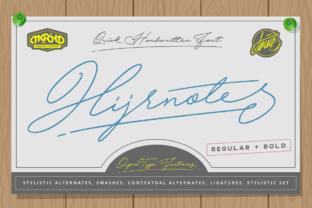
Hijrnotes ships in two weights—Regular and Bold—and it comes loaded with OpenType features that give you hundreds of alternate characters to work with. If you have ever felt limited by a font that only offers one version of each letter, you will appreciate what this typeface brings to the table. It is designed for people who need flexibility without sacrificing personality.
What Actually Sets Hijrnotes Apart
You can find handwritten fonts anywhere. What makes Hijrnotes worth a closer look is the combination of its origin and its technical depth. Because it was created with a stylus, the letterforms retain natural variation in stroke thickness and angle. The Regular weight feels light and approachable, perfect for body text in small doses or for layouts that need warmth. The Bold weight carries more presence. It works well when you need the text to stand out without losing the handwritten feel.
The OpenType features are where this font really flexes. With hundreds of alternate glyphs, you can avoid the repeating-letter problem that plagues many script fonts. If the word "great" appears twice in a design, each instance can look different. That matters for logos, quotes, and any project where repetition becomes visually obvious. You can access these alternates through software like Adobe Illustrator, InDesign, or even Affinity Designer. The font responds well to contextual alternates and stylistic sets, meaning you can fine-tune the look down to individual letter pairs.
Where Hijrnotes Shines in Real Projects
I have tested Hijrnotes across several common design scenarios, and it performs best in contexts where personality and readability need to coexist. Here are some of the most practical applications:
- Autograph and signature design. Because the font has natural variation, it works well for creating mock signatures or personal branding marks. The Bold weight is especially effective here, as it mimics the confidence of a practiced hand.
- Name cards and business cards. Pair Hijrnotes with a clean sans-serif for contact details, and use the script for the name itself. The contrast adds visual interest without feeling forced.
- Neon sign mockups. The handwritten strokes translate surprisingly well into neon-style treatments. The irregular pressure points in the letterforms read as natural glow variations.
- Quote typography and posters. This is perhaps the most natural use case. For social media graphics, posters, or flyers, Hijrnotes gives quoted text a personal, lettered-by-hand feel. The contextual alternates help long quotes avoid looking repetitive.
- Product packaging and labels. Small-batch products, artisan goods, and handmade items benefit from a typeface that looks like it was written by the maker. Hijrnotes fits that aesthetic without requiring custom lettering for every label.
Practical Considerations Before You Use It
No font is perfect for everything, and Hijrnotes has its own strengths and limitations. Being transparent about those will save you time and frustration.
Legibility at small sizes. The Regular weight is legible down to around 10 or 11 points for short text, but for longer reading passages, you will want to keep it above 14 points. The Bold weight holds up better at smaller sizes, so consider using it for subheadings or short labels.
OpenType support is essential. To get the full value from this font, you need software that supports OpenType features. If you work mainly in Canva or a basic word processor, you will still get the base characters, but you will miss the alternate glyphs and contextual substitutions. For designers using professional tools, this is a non-issue.
Pairing recommendations. Hijrnotes pairs well with neutral sans-serif typefaces like Inter, Work Sans, or even a classic Helvetica. Avoid pairing it with another elaborate script or a highly decorative display font. Let Hijrnotes be the voice, and keep the supporting type clean and quiet.
Who Benefits Most from This Typeface
This font is not aimed at one specific industry. It is useful across a surprisingly wide range of contexts:
- Freelance designers and creative agencies. Having a versatile handwritten font in your library saves time when a client needs a quick mockup for a logo or packaging concept.
- Small business owners and entrepreneurs. If you handle your own branding, Hijrnotes gives you a professional-looking script without hiring a lettering artist for every sign or label.
- Educators and content creators. For course materials, presentation slides, or social media content, the handwritten style adds a personal touch that standard fonts cannot match.
- Bloggers and publishers. Use it for pull quotes, headers, or decorative elements. It breaks up long text blocks and adds visual rhythm.
- Marketers and brand managers. For campaigns that need to feel approachable or handmade, Hijrnotes communicates warmth without sacrificing professionalism.
How to Get the Most Out of Hijrnotes
Based on working with this font across multiple projects, here are some practical recommendations:
- Map your alternate glyphs early. Open the font in your design software and browse through the stylistic sets. Identify the letter variants you prefer for common characters like 'a', 'g', 'e', and 's'. Having those ready speeds up your workflow.
- Use the Bold weight for emphasis, not body text. The Bold weight has more visual weight and works best for names, headings, and short phrases. Reserve Regular for longer text.
- Adjust tracking for readability. Handwritten fonts sometimes need a little extra space between letters to maintain legibility. Experiment with loose tracking, especially in the Regular weight.
- Layer it subtly. For posters or flyers, try using Hijrnotes in a light color over a subtle texture or photograph. The handwritten quality blends well with organic backgrounds.
- Test it in context. Before committing to a full project, test Hijrnotes at the actual size and medium you plan to use. A font that looks great on screen at 72 points may behave differently in print at 12 points.
A Final Observation on the Value of Handwritten Fonts
Typography trends come and go, but the desire for authentic, human-centered design is not a trend. It is a response to the digital saturation we all experience. When every other brand uses the same sans-serif system fonts, a carefully chosen handwritten typeface can make your work stand out without shouting. Hijrnotes does not try to be flashy. It simply does what a good handwritten font should do: it makes text feel as though someone actually wrote it.
The collaboration with Mans Greback brings a level of craft that shows in the details. The alternate characters are not just gimmicks; they are functional tools that let you tailor the font to your specific layout. Whether you are designing a name card for a client, a neon sign mockup for a proposal, or a quote poster for social media, Hijrnotes gives you the flexibility to make it look intentional rather than generic.
If you have been searching for a handwritten font that balances character with practicality, this one deserves a place in your toolkit. It is not the answer to every design problem, but for the problems it solves, it solves them well.